If you’re googling what happens to your body when you donate stem cells, you’ve probably already thought about signing up and just want the full picture before you do. Good. That’s exactly what this is for.
There are two ways to donate. Most donations in Australia use a method called PBSC, where stem cells are collected from your blood. A smaller number use bone marrow donation, where doctors collect them directly from the hip bone. This covers both, from the days before donation through to the other side.
First, a quick note on how donation works
There are two ways to donate stem cells. The vast majority of donations in Australia use a method called Peripheral Blood Stem Cell donation, or PBSC. A small number use bone marrow donation, where doctors collect stem cells directly from the hip bone. This post covers both, but PBSC gets most of the space because that’s what most donors actually go through.
In both cases, your body replaces what it gives. That’s worth knowing before you read any further.
What happens to your body before a PBSC donation
A few days before you donate, you receive daily injections of a medication called G-CSF, or granulocyte colony-stimulating factor. It encourages your body to produce more blood stem cells and push them out of the bone marrow into the bloodstream, where the collection machine can reach them. Most people choose to self-inject at home after a quick training session, which is a lot more convenient than making a trip to a clinic every day.
Your body responds to this like it’s being asked to work a double shift. Some donors feel nothing much. Others notice aching in the lower back, hips, or legs, mild headaches, tiredness, or flu-like symptoms in the days leading up to donation. These effects are temporary and ease off once the G-CSF course finishes and donation is complete.
The G-CSF period is actually where most of the soreness sits. The donation itself tends to be a lot calmer than people expect.
You can find a full breakdown of what to expect in our guide to the risks of donating stem cells.
What happens on donation day
On the day, you head to a hospital or donation centre. The team places a soft plastic cannula in each arm. Not a needle, a cannula, so you can move around and stay reasonably comfortable. Blood moves out through one arm, passes through an apheresis machine that separates out the stem cells, and returns through the other arm. Your body keeps most of its blood the whole time. The machine takes only what it needs.
The process takes four to five hours. Most donors spend it watching shows, scrolling, or even having a nap. The team monitors you throughout and checks in regularly. Some donors feel lightheaded or notice tingling around the mouth or hands from a temporary shift in calcium levels. The team watches for this and manages it easily.
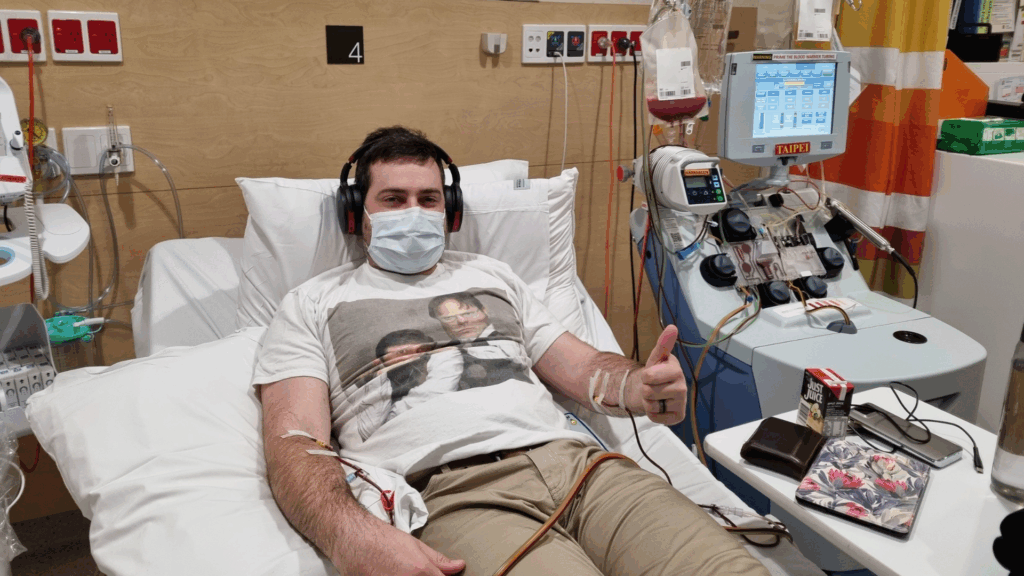
Nick during his PBSC donation. Headphones in, thumbs up, four to five hours, done.
How your body recovers
Most donors feel tired or a bit achy for a day or two after PBSC donation. Some notice bruising or soreness around the cannula sites. If the G-CSF aches haven’t fully cleared, they usually settle within a day or so of the donation finishing. Paracetamol handles most of it. But the doctors can prescribe you something stronger for those who need it.
Your immune system doesn’t take a hit from this. Donating stem cells doesn’t weaken your defences. Your body gets to work replacing what it shared, and most donors are back to normal within a couple of weeks.
What about bone marrow donation?
Bone marrow donation is far less common. Fewer than one in ten donors donate this way, and doctors usually recommend it when the patient is a baby or small child, or when it gives the patient a better shot at recovery.
You go under a general anaesthetic. Doctors use a needle to collect stem cells from the back of your hip bone. The procedure takes around 45 minutes and you wake up not remembering any of it, which is arguably the least stressful part of the whole thing.
Afterwards, most donors describe a bruised or sore feeling around the hips that settles over one to two weeks. Your body replaces the marrow over the following weeks.
Whatever the method, the final choice is always yours. The doctors might have a preference based on what gives the patient the best outcome, but you always have the final say. And when you could be the only person on the planet whose stem cells could save someone’s life, no one is going to argue with how you choose to give them.
Ready to be on the list?
If you’re aged 17 to 35 and generally healthy, you can register in a few minutes online. A cheek swab kit arrives in the mail. You swab, you send it back, you’re on the registry. That’s it.
Most people who join the registry never get called to donate. But for the person waiting on a match, the registry is everything.
Sign up through the TLR Foundation’s partner page.
Be a legend. Save a life.