You’ve done the cheek swabs. Posted them back. Got the confirmation email. And now you’re wondering what actually happens after you register as a stem cell donor.
Honestly, not much. At least not straight away. You go back to work, uni, whatever you were doing before. Your life doesn’t change. But behind the scenes, something important is happening with those swabs.
Your swabs tell the registry everything it needs to know

The cheek swabs are the easy part. What happens next is where it gets interesting.
When your cheek swabs arrive at the lab, scientists analyse them to map your HLA type. HLA stands for human leukocyte antigen, and it’s essentially your immune system’s fingerprint. No two people have exactly the same combination unless they’re identical twins.
Your HLA type is what doctors use to match donors to patients needing a stem cell transplant. It’s not about blood type. It’s about genetics. If you want to understand how that process works in detail, we’ve explained it all in how stem cell donors are matched.
Once the lab maps your HLA type, the registry stores your results and lists them anonymously on international databases. That means a patient anywhere in the world could potentially match with you. More than eighty percent of Australian patients who need a stem cell transplant rely on a donor from overseas, so registries sharing data across borders is what makes this whole system work.
After that, you wait. There’s nothing else you need to do. No follow up appointments, no blood tests, no annual check ins. You just carry on with your life.
Most people never get a call
This is the part nobody really talks about. Most people who register as a stem cell donor never hear from anyone. You could sit on the registry for decades without a single phone call. That doesn’t mean registering was pointless. It means nobody needed your specific HLA type yet.
But if your HLA type does match a patient, you’ll get a call. It might come months after registering. It might come years later. And when that call comes, you’re not just a name on a list anymore. You’re a potential match for someone who’s run out of other options.
The team will ask if you’re still willing to donate. You can say yes or no. There’s no pressure and no obligation. But you didn’t register by accident. You made a choice to be there.
In some cases, you could be the only person in the world who matches that patient. Not one of many. The one.
If you ever change your mind about being on the registry, let Stem Cell Donors Australia know so they can remove you. Staying registered when you’re no longer willing to donate can create false hope for patients and their families. It’s a simple conversation, and nobody will judge you for it.
If you’re confirmed as the best match
If further testing confirms you’re the best match, things move from possible to planned. You’ll have a full medical assessment first. If doctors have any concerns about your health, it won’t go ahead.
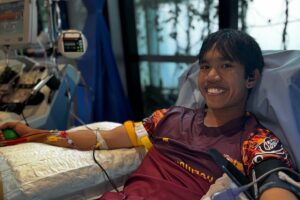
Charles during his stem cell donation. Most of the day looks exactly like this.
About ninety percent of stem cell donations in Australia happen through a process called PBSC, where an apheresis nurse collects stem cells from your bloodstream. Five days before donation day, you’ll start injections of a medication called G-CSF, which tells your body to produce more stem cells than usual. Most donors describe the side effects as slightly annoying, but very manageable. Temporary aches, feeling a bit run down, maybe some bone pain. It passes.
On donation day, you sit in a chair while an apheresis machine filters stem cells from your blood. You’ll have a cannula in each arm, so both arms stay put for a while. Bring your phone, a charger, something to watch. The whole thing takes five or six hours, and most of that time you’re just sitting there wondering what all the fuss was about. If you want to know what the injections do and what to expect from them, we’ve covered it in why you need injections before donating stem cells.
Around ten percent of donations involve collecting stem cells from the hip bone under general anaesthetic. If the patient’s doctor recommends this method, your medical team explains everything clearly in advance. You’ll understand the risks. You’ll ask questions. And you always have the final say on the donation method.
Nothing happens without your consent. At every stage, your medical team keeps you informed and welcomes any questions you have. This isn’t something that happens to you. It’s something you choose to do.
Now help someone else do the same
If you’ve already registered, the single best thing you can do is tell someone else about it. Share this page. Mention it to a mate. Post about it. The registry grows one person at a time, and most people have never even heard of it until someone they know brings it up.
You didn’t need a medical degree or a reason to register. You just needed to care enough to do the cheek swabs. Chances are, someone in your life would do the same if they knew it existed.
If you haven’t registered yet and you’ve made it this far, you’re clearly thinking about it. If you’re aged 17 to 35 and in good health, you can register as a stem cell donor with a few simple cheek swabs and a couple of minutes. Sign up through the TLR Foundation’s partner page.
Be a legend. Save a life.