If you’ve just typed “does donating stem cells hurt” into Google, you’re probably already thinking about signing up. You want the real answer before you commit. That’s fair.
So here it is. The lead-up can be a bit achy. Donation day itself is mostly just long. And the whole thing is done faster than most people expect. No one’s going to pretend it’s completely painless, because that would be a lie. But it’s nowhere near what most people picture when they hear “stem cell donation” for the first time. There’s no surgery involved for the most common method, no long hospital stay, and no reason to spend a week on the couch afterwards. The reality is a lot more mundane than the fear.
What does donating stem cells feel like?
In Australia, the vast majority of stem cell donations happen through a process called peripheral blood stem cell collection. It works a lot like giving plasma. Blood leaves one arm, passes through a machine that separates the stem cells, and goes back into the other arm. The whole thing usually takes five or six hours, which means you’ll need to take the day off. Not the week. The day.
A smaller number of donations involve collecting bone marrow directly from the hip bone. That happens in hospital under general anaesthetic, so you won’t feel it during the procedure. You’ll be sore around the collection site for a week or so afterwards, similar to a deep bruise, but it fades. Doctors request this method when the patient’s treatment plan specifically calls for it, but it’s far less common. Either way, donors always have the final say on which method they’re comfortable with.
Most of the “does it hurt” question actually comes down to the days before donation, not the day itself.
The days leading up to donation day
If you’re confirmed as the best match for a patient, you’ll start daily injections of a medication called G-CSF five days before donation day. G-CSF tells your bone marrow to produce extra stem cells and push them into your bloodstream so the collection team can do their thing.
The needles are small. Think insulin needle, not something from a horror film. Some donors give the injections themselves at home and others have a nurse do it. You’re not locked into either option.
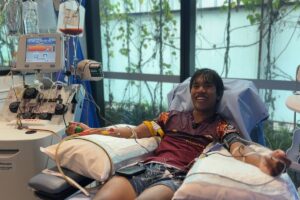
Charles was 20 when he donated and had zero side effects from the G-CSF injections
The side effects during those few days are where most donors actually notice something. Achy bones, sore muscles, maybe a headache or some fatigue. Your bone marrow is in overdrive, producing far more stem cells than usual, and your body lets you know about it. A couple of paracetamol usually takes the edge off. Some donors barely notice anything at all. Charles had zero side effects from the injections. The side effects ease off quickly once the injections stop. If you want the full breakdown of what G-CSF involves and what donors say about it, our injections blog covers it step by step.
For most donors, this stretch is the part they’d describe as noticeable. Not the donation itself.
Does donating stem cells hurt on the day?
Donation day is anticlimactic in the best possible way. An apheresis nurse places a cannula in each arm. That’s a small flexible plastic tube, not a needle that stays in for five or six hours. The insertion feels similar to giving blood, a quick pinch and then it’s done. Once everything’s connected, there’s not much to feel at all.
Both arms are out of action for the session, so someone else is on remote control duty. Most donors spend the time watching Netflix, having a nap, or chatting with the nursing team. The biggest risk on donation day is running out of things to watch. Stefan actually fell asleep towards the end of his. It happens.
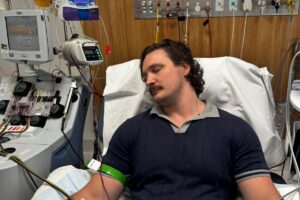
Proof that some people really do have a nap.
Some donors notice a slight tingling or coolness during collection, which is a normal response to the process. It’s mild and the nursing team keeps an eye on it throughout.
Your body starts replacing the donated stem cells straight away. Most side effects from the G-CSF injections settle within a day or two, and plenty of donors only take donation day itself off work. If you want to know what recovery actually looks like, we’ve written about that separately in our recovery blog.
Should the pain question stop you?
You don’t need to be tough to do this. You just need to know what’s coming so nothing catches you off guard.
Most people who join the stem cell donor registry never get called. The registry exists for when a patient with blood cancer needs a transplant, and matches are rare. But if you are matched, a medical team walks you through every step and you have the right to say no at any point.
If you’re aged 17 to 35 and living in Australia, signing up takes a few cheek swabs through the post. And if the biggest thing holding you back was the question does donating stem cells hurt, you’ve now got your answer. It’s temporary, it’s manageable, and for the person on the other end, it could be everything.
Sign up through the TLR Foundation’s partner page.
Be a legend. Save a life.