Become a Stem Cell Donor
You could save someone’s life by becoming a stem cell donor.
Every year over 20,000 Australians are diagnosed with blood cancer or other serious blood disorders. For some people, a stem cell transplant is their only option.
By joining Stem Cell Donors Australia, you could be the person someone’s waiting for. Signing up is straightforward, and if you’re ever matched, your stem cells could help give someone a second chance at life.
Most people who join the registry will never get the call. But if you are matched, you could be the only person in the world who can help. That’s why we focus on explaining the process clearly and dispelling common myths so people can make an informed decision before they sign up.
Aussies are diagnosed with blood cancer every year
of stem cell donations happen through the blood
You could be the one person someone needs
What's involved?
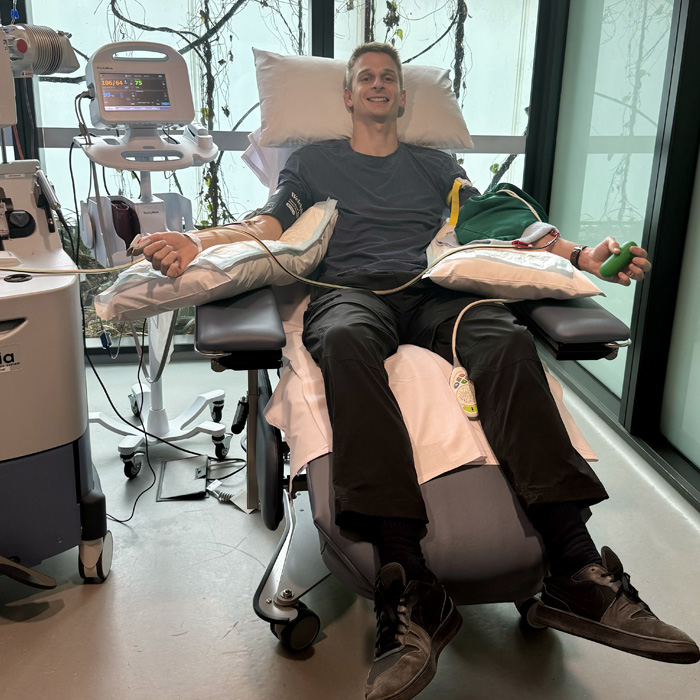
Donating stem cells is easier than you think. The most common method, in around 90 percent of cases, happens through the blood. If you’re asked to donate, you’ll have four daily injections that make your body produce more stem cells. These move the extra stem cells into your bloodstream, and on donation day you’ll spend about four to five hours connected to a machine that collects them.
It’s just like a long plasma donation. Blood comes out of one arm, stem cells are filtered out, and the rest of your blood is returned through the other arm. Most donors watch YouTube, scroll their socials, or binge Netflix.
For most people, this is what donating stem cells is like. Calm, simple, and quietly legendary.
The other way to donate
In this case, stem cells are collected from the back of the hip bone while you’re under general anaesthetic. You’re asleep the whole time. The procedure usually takes around 45 minutes, and there are no daily injections leading up to it.
Who Can Donate Stem Cells?
You can join the stem cell donor registry if you’re aged 18 to 35, in good general health, and hold a green or blue Medicare card.
There are some medical exclusions, which are checked as part of the sign-up process. If something means you’re not eligible, you’ll be told clearly and early on.
If that sounds like you, you can sign up and be added to the Aussie registry. You won’t be asked to donate unless you’re matched with someone who needs your stem cells.
If you’re overseas or not eligible here, you can still help by joining the stem cell donor registry in your own country.

What Role Does Ethnicity Play?
Finding a stem cell match comes down to tissue type, not blood type. Because tissue type is inherited, people are more likely to match with someone who shares a similar ethnic background, or mix of backgrounds.
Right now, Australia’s donor registry doesn’t fully reflect the diversity of the people who live here. That’s why more than 80 percent of Aussies needing a transplant rely on donors from overseas, and why more local donors really matter.
When people from diverse backgrounds join the registry, it helps close that gap and gives more people a real chance at finding their match.
A Donor’s Story
Mark, a young Aussie donor, shares his experience donating stem cells. His story inspired Jack to join the registry himself. Proof that hearing from a real donor can make all the difference.
How To Become a Stem Cell Donor
Check If You’re Eligible
Are you 18-35, in good health, and have a Medicare card? If yes, you’re ready to go!
Sign Up Online
Head over to the sign-up page on Stem Cell Donors Australia and enter your details. You’ll get a cheek swab kit sent directly to your door.
Swab Your Cheeks
Quick, easy, and painless. Pop the swabs back in the mail, and you’re officially on the registry.
Stay Ready
If you’re a match, the team at Stem Cell Donors Australia will call to guide you through the next steps.
FAQs
What is stem cell donation?
Stem cell donation is when someone donates their blood forming stem cells to help treat a person with blood cancer or a serious blood disorder.
For some people, a stem cell transplant isn’t one option among many. It’s their only chance.
Most stem cell donations happen through the bloodstream and feel a lot like a long plasma donation. It’s usually much simpler than people expect.
Why do people need a stem cell transplant?
People need a stem cell transplant when their bone marrow can’t make healthy blood cells on its own.
This can happen because of blood cancers like leukaemia or lymphoma, or other serious blood disorders.
A stem cell transplant gives their body a chance to rebuild healthy blood cells again.
How does stem cell donation actually work?
First, you sign up with Stem Cell Donors Australia and a cheek swab kit sent to your door.
If you’re ever matched with someone who needs a stem cell transplant, you’ll be contacted and guided through the process step by step.
Most donations involve collecting stem cells from your bloodstream. You’re looked after the whole time, and most people are back to normal very quickly.
Is donating stem cells painful?
Short answer, for most people, no.
For the majority of people the donation itself is similar to a long plasma donation. You’re awake, comfortable, and can read, scroll, or even nap while it’s happening.
Some people feel tired or a bit achy for a short time, but serious pain isn’t the norm.
Is donating stem cells safe?
Yes. Donating stem cells is considered very safe.
It’s a well established medical process, with thousands of people donating stem cells around the world each year.
Donors are carefully checked before anything happens, and you’re supported throughout the entire process.
Most people recover quickly and get back to normal life straight away. You’d be doing something pretty legendary along the way.
How long does it take to donate stem cells?
For most people, the donation itself takes four or five hours on the day.
There’s also some preparation beforehand, which your medical team will guide you through, so nothing comes out of the blue.
Most donors are back to normal life the next day.
Who can join the Australian Stem Cell Donor Registry?
You can join if you’re aged 18 to 35, generally healthy, and hold a green or blue Medicare card.
That’s it. No special background needed.
If you’re eligible and ever come up as a match, you may be able to save the life of someone with blood cancer.
Why do I have to be aged 18 to 35 to join?
Younger stem cell donors give patients the best chance of a successful transplant. It’s not personal. It’s biology.
That’s why registries around the world focus on recruiting people in this age group.
If you’re aged 18 to 35, you’re in the sweet spot where you can make the biggest difference.
Do I need to be Australian to join the stem cell donor registry?
You need to be an Aussie citizen or a permanent resident to sign up. That’s because you must hold a green or blue Medicare card.
If you’re living in Australia on a temporary visa, you can still join a stem cell donor registry in your home country.
Stem cell registries around the world work together, so donors can help patients across borders.
How do I sign up to be a stem cell donor?
You can sign up online. It takes a few minutes.
If you’re eligible, a cheek swab kit is sent to your door. You swab your cheeks, send it back, and you’re on the registry.
You can also join the stem cell registry when donating blood or plasma at Lifeblood.
Either way, signing up is quick and straightforward.
What happens after I sign up?
Once you’ve signed up, your details are added to the Australian Stem Cell Donor Registry.
Most people never get a call, and that’s normal.
If you’re a match for someone who needs a stem cell transplant, you’ll be contacted and looked after at every step of the process.
How are stem cell donors matched to patients?
Matching is based on tissue type, not blood type.
Tissue type is inherited, which means people are more likely to match with someone who shares a similar ethnic background, or mix of backgrounds.
That’s why having a large and diverse stem cell donor registry really matters.
Is matching based on blood type?
No. Blood type doesn’t matter when matching stem cell donors.
Matching is based on tissue type, which comes from your genes.
That’s why someone with a similar ethnic background, or mix of backgrounds, is more likely to be a match.
Why does ethnic background matter when finding a match?
Because tissue type is inherited.
People are more likely to match with someone who shares a similar ethnic background, or mix of backgrounds.
That’s why increasing diversity on the stem cell donor registry really matters.
Why does Australia rely on donors from overseas?
Australia’s stem cell donor registry doesn’t fully reflect the diversity of the people who live here.
Because matching is based on genetics, many people can’t find a suitable match locally.
That’s why more than 80 percent of Australians who need a stem cell transplant rely on donors from overseas.
What's it actually like to donate stem cells?
For most people, it’s pretty uneventful.
The donation usually feels similar to a long plasma donation. You’re awake, comfortable, and can read, scroll, or nap while it’s happening.
It’s a big deal for the person receiving the cells. For most donors, it’s a few hours out of their day. You’d be doing something pretty legendary along the way.
Are there different ways to donate stem cells?
Yes, but most stem cell donations happen through the bloodstream.
A much smaller number involve collecting stem cells from bone marrow, which is done under anaesthetic.
Either way, you’re supported the whole time, and the medical team will guide you through exactly what to expect.
What are the risks of donating stem cells?
The risks of donating stem cells are incredibly low.
Whether it’s through the blood or direct from the bone marrow, it’s a well established medical process, and donors are looked after every step of the way.
Most side effects are short term and manageable, like feeling tired or achy for a few days. Serious complications are rare, and you’re supported the whole way through.
Are there any long term risks from donating stem cells?
No. There’s no evidence that donating stem cells causes long term health problems for donors, and hundreds of thousands of people have donated stem cells worldwide.
Your body naturally replaces the stem cells you donate.
Donors are followed up after donation, and most people go on with life exactly as before, just knowing they helped save someone’s life.
What are the side effects of the G-CSF injections?
The G-CSF jabs tell your body to produce extra stem cells before donation.
Some people feel flu like symptoms for a few days, have some bone or muscle aches, headaches, or make you feel tired on the lead up to donation day. This is totally normal and shows the G-CSF is working.
The side effects are temporary and usually settle once the injections stop. You’re supported the whole time.
How long do G-CSF side effects last?
For most people, side effects last a few days while you’re having the jabs.
They usually settle quickly once the injections stop.
Most donors are back to feeling like themselves the next day.
Will I need time off work or Uni to donate?
Most people will need a day off for the donation itself.
Some people also take a day or two around it, just to rest.
You’ll know what’s involved well in advance, so you can plan around work or uni.
Will I be out of pocket if I donate stem cells?
No. You won’t be out of pocket.
If you’re asked to donate your stem cells, all costs related to the donation are covered, including travel, accommodation, and food.
Donating won’t cost you anything. You Legend.
Will I get paid to donate stem cells?
No. Donating stem cells isn’t paid.
It’s a voluntary donation, not a job.
You’re giving someone a chance at life when they’ve usually run out of options. That’s a pretty incredible thing to do.
How often could I be asked to donate?
For most people, it’s very unlikely to donate even once.
There are over 43 million people on stem cell donor registries worldwide, and most will never get a call.
If you are asked, it’s because you’re a close genetic match for someone who needs a stem cell transplant.
There have been a handful of cases where a donor is asked to donate again for the same person, but that’s incredibly rare.
Can I meet the person I donate to?
Usually, no. Donors and recipients are anonymous at first.
In Australia, donors and recipients can choose to connect after two years. This can vary depending on the country. It only happens if everyone involved is comfortable with it.
Either way, you’ll know that you helped someone when they needed it most. That part doesn’t depend on meeting.
Can I change my mind after joining the registry?
Yes, absolutely. You can withdraw from the stem cell donor registry at any time.
That said, joining the registry is a serious commitment. By the time someone is searching for a match, they’ve often been through months of treatment and are waiting on one person.
That’s why it’s important to understand what’s involved before you sign up. Saying yes upfront helps avoid giving someone false hope later on.
If something genuinely changes, you can let Stem Cell Donors Australia know and they’ll remove you from the registry.
What support is available if I donate?
You’re supported at every step of the way and into the future.
If you’re a match, you’ll have a dedicated medical team guiding you through each step, answering questions, and checking in on you before and after donation.
You’re not doing this alone. There’s a lot of care wrapped around donors, because what you’re doing really matters.
What’s TLR’s role in stem cell donation?
The TLR Foundation exists to get more people signed up as stem cell donors.
We do this by educating people about stem cell donation, sharing real stories, and helping break down the myths that stop people from signing up.
We don’t run the registry. We help people understand it and join it. We help find legends.
Am I signing up with TLR or Stem Cell Donors Australia?
You’re signing up with Stem Cell Donors Australia.
TLR is an official charity partner. Our role is to educate, encourage, and help more people join the registry.
When you sign up through TLR, it means our small, volunteer run charity is doing its job. And that matters to us.
Be a Legend, Save a Life
If you’re aged 18 to 35, you could be the one person someone is waiting for. Signing up as a stem cell donor is easy and starts with a few simple cheek swabs sent to your door.
Most people who join the registry will never get the call. But joining means someone, somewhere, has a better chance of finding their match.