A blood cancer diagnosis doesn’t come with a warning. One day life is normal, and then it isn’t. For some people, chemotherapy works. For others, a stem cell transplant becomes the only real option left.
That’s why the benefits of stem cell donation aren’t abstract. For some patients, a matching donor is the difference between having options and running out of them entirely.
What blood cancer does to the body
Blood cancer attacks the system your body relies on to survive. It stops the body from making healthy blood cells, which means the immune system weakens, the body struggles to carry oxygen, and recovery from even basic treatment gets harder and harder.
Chemotherapy and radiation can kill cancer cells, but they can also wipe out the healthy blood-forming cells at the same time.
When that happens, the body can’t just rebuild on its own. It needs help from somewhere else.
The benefits of stem cell donation for patients
Healthy donor stem cells give the body a new starting point. Once they’re infused, they travel to the bone marrow and begin making new blood cells. Over time that rebuilds the immune system, gets healthy blood cell production back on track, and gives the body a fighting chance to recover from treatment.
For some patients this means more treatment options open up. For others it’s the thing that makes survival possible at all.
It’s not a guaranteed outcome and stem cell transplants are serious. Recovery takes real time and real support. But for many people with blood cancer, a matching donor is the difference between having a path forward and running out of road entirely.
It’s not just about treatment. It’s about time.
When people think about stem cell donation they usually think about the donor. Fair enough. But the person on the other end of that match is someone’s child, parent, sibling, best friend, or partner.
For them, donated stem cells can mean more birthdays. More ordinary Tuesdays that suddenly don’t feel ordinary at all. More time with the people who matter most.
Trace Richey, the man whose experience inspired The TLR Foundation, received a stem cell transplant.
That’s why this organisation exists and why growing the registry matters so deeply to everyone involved with TLR.
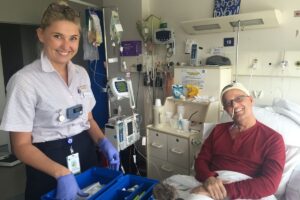
Trace at the beginning of his stem cell transplant. His story is the inspiration behind The TLR Foundation.
Why finding a match can be so hard
Stem cell matching comes down to genetics, not blood type.
Doctors look for a donor whose tissue type is as close a match as possible to the patient. The closer the match, the better the chance of a safer transplant and a smoother recovery.
Some patients find a match within their family. Still, many don’t. When no family match exists, doctors search the stem cell donor registry. If the right person isn’t on it, the transplant can’t go ahead.
That’s the reality. It isn’t always about medicine or timing or effort. Sometimes it comes down to whether the right person has joined the registry yet.
To understand how the matching process works, read How Are Stem Cell Donors Matched?
That’s a hard thing to sit with, and it’s exactly why the registry needs more donors.
Why diversity on the registry matters
Tissue type is inherited, which means people are more likely to match with someone who shares a similar ethnic background. If the registry doesn’t reflect the full diversity of Australia, too many patients face a much harder search.
Right now, that’s exactly what’s happening. People from Asian, Aboriginal and Torres Strait Islander, African, Middle Eastern, and Pacific Islander backgrounds are underrepresented on donor registries. That makes finding a match significantly harder for patients from those communities, and for some it means no match at all.
Every new donor helps. Every person from every background who joins the registry improves the odds for someone who might be searching right now and coming up empty. You don’t have to be called to donate to make a difference. Just being on the list matters.
But what does donating stem cells involve?
This is the bit people quietly wonder about before they commit to anything.
Joining the registry is just a cheek swab at home. That’s it for now. Most people who join are never called to donate at all. If you are matched, you go through a full medical assessment before anything happens and get to ask every question you have.
The most common donation method is peripheral blood stem cell collection, which works like a long plasma donation. A few achy days beforehand from the injections, five or six hours in a chair on donation day, and most donors are back to normal within a day or two.
Not nothing, but also not what most people imagine when they think about the benefits of stem cell donation.
For the full picture of what donation actually involves, read What Really Happens to Your Body When You Donate Stem Cells.
Ready to put your hand up?
So if you’re aged 17 to 35, generally healthy, and hold a green or blue Medicare card, you could join today.
Just a few minutes online, then a cheek swab kit’s delivered to your door.
Most people who sign up will never get that call. But for the patients who do find their match, it’s everything.
Sign up through the TLR Foundation’s partner page and be the reason someone gets another chance at life.
Be a legend. Save a life.