Aadil was three or four months into being on the stem cell donor registry when his phone rang. He’d signed up during a blood donation at work, ticked an extra form, and more or less forgotten about it. They’d told him the odds were about one in a thousand. He figured he’d never hear from them again.
Then someone needed him.
He was 30, working in HR data analytics for an insurance company, and about to start parental leave with his 11 month old son. The timing wasn’t ideal. But the person on the other end of that call needed a stem cell transplant, and Aadil was their match.
“You feel kind of special, because you are the match and you’re the one person that can actually make a difference at this point. So it’s quite a privilege.”
He said yes.
What donating stem cells was actually like
Aadil donated at the Kinghorn Cancer Centre, part of St Vincent’s Hospital in Sydney. For five days beforehand, he had daily G-CSF injections to move stem cells from his bone marrow into his bloodstream. Then he spent a few hours in a chair while a machine drew blood from one arm, filtered out the stem cells, and returned the rest through the other.
“It’s just like a long plasma donation. A few jabs on the days leading up to this, then you just sit here for a few hours. You can watch something, read something, and then that’s it.”
Aadil spent the time listening to an audiobook.
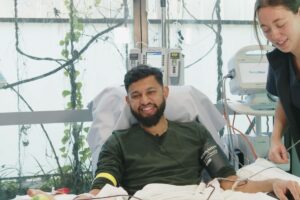
“I’m usually busy with my kid. This was actually quite relaxing.”
The self-injection bit
Donors getting G-CSF injections can either have a nurse do it or self-inject at home. Aadil chose to do it himself.
He admits the first one was confronting.
“Before doing it and then seeing the needle, it’s like, oh my god, I’m going to inject this. It might be painful, but when you actually do it, it’s not so bad. The needle is very sharp. It goes in very quickly and comes out very smoothly.” After the first jab, the rest got easier.
Side effects were mild. Some aches in his lower back, thighs, and shoulders, plus a few headaches. He took some Panadol and got through it.
“Maybe you feel a little bit off for a couple days before, but it’s nothing that major. And if you consider what you’re potentially doing for someone, I think it’s totally worth it.”
Why Aadil’s background matters more than he knew
When Aadil signed up, he assumed matching worked the same way as blood. Most people do. He had no idea his ethnic background had anything to do with it.
Aadil’s an Australian of Sri Lankan heritage. Stem cell matching is about tissue type, not blood type, and those tissue types follow family ancestry. Patients are most likely to find a match from someone who shares a similar ethnic background. Right now, there’s a real shortage of South Asian and Sri Lankan donors on the Australian registry, and patients from those communities are some of the hardest to match.
“I had no idea that diversity mattered so much. I didn’t realise how few people from my community were actually on the registry. That really hit me.”
More than 80% of Australian patients needing a stem cell transplant rely on overseas registries to find a match. That’s largely because the local registry doesn’t yet reflect the diversity of the people who actually live here.
Aadil’s donation went to someone with a similar background to his own. Someone who might not have found a match at all if he hadn’t ticked that extra form during a blood donation. Since donating, he’s been talking to friends and family about signing up. He knows the more people from underrepresented communities who join, the fewer patients left without options.
Something only you can give
Aadil keeps coming back to one idea. Most of us help others by giving time, skills, or money. Those things matter, but other people can give them too. Stem cell donation’s different.
“Often, what really can make a difference is only something that only you can do. In this case, only you have the tissue that’s required for this person. Something only you can do. That’s what can actually make such a big difference, because nobody else except you can do it.”
There might be one person in the world who’s a match for someone with blood cancer. If that person hasn’t signed up, the search comes to a dead stop. No amount of money or goodwill fills that gap. Only the right tissue type does.
“It’s almost hard to process that you can make that much of a big difference in someone’s life. It’s not something you get to do every day.”
Could you be someone’s match?
Most people who join the registry will never get the call. Aadil didn’t expect to either. But he did, and he reckons it was one of the most meaningful things he’s ever done.
If you’re aged 18 to 35 and have a valid Medicare card, all it takes is a short form and a few simple cheek swabs. Sign up through the TLR Foundation’s partner page.
Be a legend. Save a life.