Josh joined the stem cell donor registry less than two years before he got the call. He was 29, living in Sydney, and figured if he could help someone one day, why wouldn’t he. It wasn’t something he spent a lot of time thinking about. He signed up and got on with his life.
Most people who join the registry never get the call. Josh did.
Someone overseas urgently needed a stem cell transplant, and Josh was a match. Then, right before his donation date, he was hit by a car. For a moment, he thought the whole thing might fall through.
“With everything going on, I was just relieved it could still go ahead.”
He showed up and donated anyway.
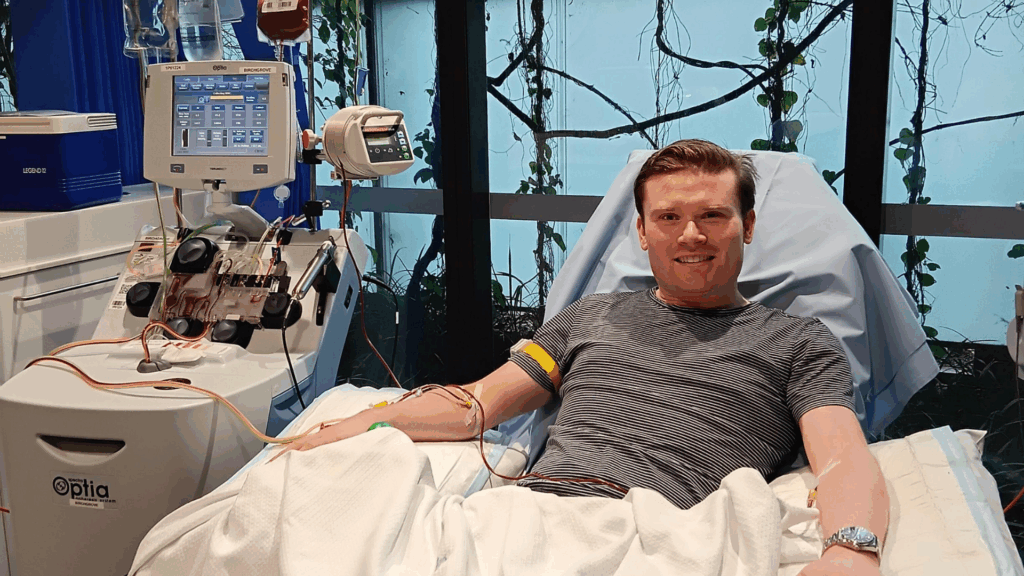
Josh donating stem cells at the Kinghorn Cancer Centre, St Vincent’s Hospital
For most people, it feels like a long plasma donation.
What donating stem cells was actually like
Josh donated at the Kinghorn Cancer Centre, part of St Vincent’s Hospital in Sydney. For five days, he had daily injections of G-CSF, a medication that helps move stem cells from the bone marrow into the bloodstream. The injections hit Josh harder than most. He felt sore and tired and needed to rest. Between that and recovering from being hit by a car, it wasn’t the easiest week. But the team at the Kinghorn Centre looked after him the whole way through.
On the fifth day, he sat in a recliner while a machine drew blood from one arm, filtered out the stem cells, and returned the rest through the other arm. The whole process took a few hours. Most donors bounce back within a day or two as the body naturally replaces the donated stem cells.
“I think a lot of people out there have the perception that it is quite painful, time consuming and surgical and that’s definitely not the case. From the outset the whole team have been very clear about how the process works. In reality, it’s a few days of very mild disruption and the procedure is very straightforward for most cases.”
Donating to a stranger
Josh doesn’t know who received his stem cells. He knows they live overseas and urgently needed a transplant. That’s it. He doesn’t know their name, their age, or what kind of blood cancer they were fighting. None of that changed how he felt about doing it.
“Donating to a stranger doesn’t change things, it’s still as much of a responsibility, and still impactful. The fact that I don’t know who the recipient is doesn’t diminish the seriousness of what’s happening.”
“At the end of the day, we’re all human beings regardless of where we live, what country we’re from, or what our past is. We all want to love, be loved and live a life free of suffering so that’s something that connects all of us.”
When things got tough in the lead up, Josh kept coming back to one thought.
“The recipient at the other end is going through a much more difficult situation than I am and I am doing it for them, and what’s really only a few days of my life could have a huge impact for that person and their friends and family.”
Josh often thinks about the person on the other end. What their life looks like, what their situation is. He may never find out. But he knows what he did mattered, and that’s enough.
“I hope it helps them. Even if I never find out who they are, I know I have done something that mattered.”
Why Josh thinks more people should sign up
Since donating, Josh has recruited at least four new people onto the stem cell donor registry. He’s not done either.
“I think it’s a very easy way to have a very big impact on someone else’s life, and not just that person but also their friends and family.”
“There are a lot of things that are big and scary in the world and I’m not able to fix all of them, but this is something I can do that is within my control and I can actively have a role participating in. It’s an opportunity to give hope to someone and to have a positive ripple effect in the world.”
Josh describes the whole experience as a privilege. Not just the donation itself, but the reminder that people everywhere are quietly working to bring hope and make a difference. The nurses, the doctors, the organisations that make it all possible. If you want the full picture on what donation involves, the risks of donating stem cells blog covers it in detail.
“All I really did was turn up and go along for the ride.”
Could you be someone’s match?
Most people who join the registry will never get the call. But if you do, Josh reckons it might be the most rewarding thing you ever do.
If you’re aged 17 to 35 and have a valid Medicare card, all it takes is a short form and a few simple cheek swabs.
Be a legend. Save a life.