Some people see something on the news and change the channel. Mitch saw a family on television. Their two-year-old daughter was dying from blood cancer because no one on the registry was a match. He decided he was going to do something about it.
He joined the stem cell donor registry the very next day. That was 2003. He was single, had no kids, and absolutely no idea it would take twenty years for the phone to ring.
The wait that lasted twenty years
After signing up, Mitch assumed he might hear something fairly soon. Weeks turned into months, months turned into years, and eventually the registry faded quietly into the background of a life that kept moving forward.
Then one winter evening in 2023, he was outside in the rain taking the rubbish out when his phone rang. The caller was from Stem Cell Donors Australia, the same organisation he’d registered with back in 2003, when it was still known as the Australian Bone Marrow Donor Database.
“I thought she was calling for money,” Mitch says.
She wasn’t. She asked if he remembered joining the bone marrow registry back in 2003. In that moment, everything clicked.
“It felt like I’d won the lottery. I was just so excited.”
A lot had changed in twenty years
When Mitch joined the registry, he was planning to donate bone marrow. By the time the call came, he was married with a son, Oliver. So he didn’t say yes on the spot.
He went inside, told his wife, and she told him to call back and say he was in. It also meant Oliver would grow up knowing that stepping up for a stranger is simply what decent people do.
There was also news about the process. Bone marrow donation was largely a thing of the past. These days most donors give peripheral blood stem cells, a far less invasive method with no operation and no general anaesthetic. Nothing like what Mitch had been dreading.
The injections were easier than he thought
Before donation, Mitch needed G-CSF injections, a medication that stimulates the body to produce extra stem cells. He elected to self-inject, despite describing himself as someone who really doesn’t like needles. We don’t know anyone who does.
“The psychological barrier was the worst thing,” he says. “But it really didn’t hurt.”
The side effects built gradually over four days. A little tiredness on day two, mild flu-like symptoms by day three, nothing Mitch would describe as more than a two or three out of ten. When things got a little uncomfortable, his doctor prescribed something stronger. Mitch describes the lead-up as unexpectedly enjoyable at that point, which probably says more about the prescription painkillers than the process. Most donors get through it fine with a couple of paracetamol.
If you want the full picture on what donation actually involves, the What Are the Risks of Donating Stem Cells blog has you covered.
Donation day
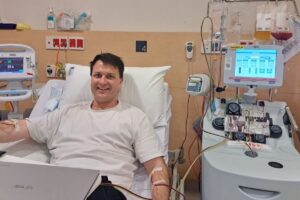
Five hours, zero complaints, and a smile that says it all
Mitch donated at Royal North Shore Hospital. His wife dropped him off in the morning and he went in alone, though he says he never felt that way once he was inside.
The process was similar to a long plasma donation. A cannula in each arm, blood out one side, the apheresis machine separates the stem cells, and the remaining blood returns through the other arm. He had food, good chat with the nurses, and five hours later it was done.
“I thought I was going to be there for a long, long time,” he says.
The staff made him feel like the most important person in the building.
Then another long wait
After donating, Mitch expected to hear how things went fairly soon. Instead, he waited again.
In Australia, donors and recipients can exchange anonymous messages after donation, but direct contact requires at least two years to pass, and only if both people agree. TLR has written about what happens after you register as a stem cell donor for anyone who wants to understand the process.
Two years after donation, a letter arrived.
“It hit me like a ton of bricks,” Mitch says. “The most emotional, well-written letter I’ve ever read.”
It wasn’t the two-year-old girl he’d pictured back in 2003. It was a bloke from northern England named Mark, and that turned out to be just fine.
He’d been diagnosed with acute myeloid leukaemia during Covid. His daughter had tried first, but it didn’t work. The search led back to the registry, and eventually to Australia, and to Mitch.
Mitch read it twice and cried both times.
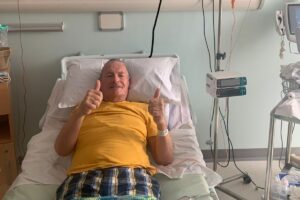
Mark in hospital in the UK during his stem cell transplant.
A new mate on the other side of the world
Once they were allowed to make contact, Mitch and Mark connected quickly and built a genuine friendship. They speak on WhatsApp regularly. Mitch sees photos of Mark out with mates, spending time with his wife and daughter, and just getting on with life.
“I feel that if I hadn’t have done what I did, he wouldn’t be here today.”
It isn’t just knowing the transplant worked that gets Mitch. It’s getting to see the life that came after it. He describes the months after donation as euphoric, the most rewarding feeling of his life. And before you ask, that had nothing to do with the prescription painkillers.
And whenever they speak, Mark ends the conversation the same way.
Thank you for saving my life.
Could you be someone’s match?
Most people who join the registry will never get the call. Mitch waited twenty years, and he still describes donating stem cells as the most rewarding thing he’s ever done.
If you’re aged 18 to 35 and have a valid Medicare card, all it takes is a short form and a few simple cheek swabs. Sign up through the TLR Foundation’s partner page.
Be a legend. Save a life.