For TLR, Stefan represents everything this foundation is working toward. Not just someone who signed up. Someone who understood what they were signing up for, knew what it would involve, and showed up anyway. A quality donor. A nurse. This is a stem cell donation story that started with TLR’s investment in cancer nursing, and ended with a stranger somewhere in the world getting a second chance at life.
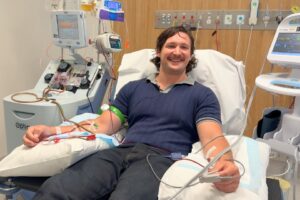
This is Stefan’s idea of a relaxing day off work.
How Stefan found the registry
Stefan didn’t stumble across the stem cell donor registry. He was shown it.
In his second year of nursing at university, Kate White, Professor of Cancer Nursing at the University of Sydney and a passionate TLR ambassador, invited TLR’s founder to speak before one of her lectures. Stefan watched online. By the time the talk was over, he’d made up his mind.
He got on his motorbike, drove in, and walked into the foyer with his helmet still in hand.
“Sign me up.”
That moment, a nursing student, a cheek swab, is exactly what TLR’s relationship with cancer nursing is built for. The scholarships, the ambassadors, the educators who open their classrooms to this story. It all leads somewhere. Sometimes it leads to Stefan.
“Anyone can do it,” he says. “It’s just whether you can be bothered to endure a tiny bit of inconvenience, or if you want to be selfish with your stem cells.”
The call came at Christmas
Stefan had been registered for a few years and didn’t expect much to come of it.
“I didn’t think I’d ever get the call,” he says. “Finding an exact match felt pretty rare.”
He was on the Central Coast for Christmas when his phone rang.
“I got the phone call and thought who is this? And then I remembered. TLR. Yes.”
His answer was immediate.
“It was a no brainer. I didn’t need a minute to think about it.”
Stefan had just graduated and was about to start in the Emergency Department at St Vincent’s Hospital. The same hospital where TLR’s Trace Richey Room stands as a permanent reminder of why this foundation exists. The donation would need to happen in his first week. Somewhere in the world, a stranger’s treatment was scheduled for that week, and Stefan was their match. There was no moving it.
“This recipient’s treatment had to happen this week,” he says. “So I was very lucky to be able to talk with my new grad coordinator and get the day off.”
He made it work.
A Stem Cell Donation Story Starts With Five Days of Injections
Stefan’s stem cell donation story ends here, injecting himself with G-CSF every day for five days before donation. G-CSF is a synthetic hormone that tells your body to massively overproduce stem cells, pushing them out of your bone marrow and into your bloodstream where they can be easily collected. For a full explainer, read our post on injections before donating stem cells.
Stefan’s a nurse. He gives injections for a living. And he still found the first one strange.
“Injecting myself for the first time was a new experience,” he says. “As a nurse it’s part of the job, but doing it to yourself for the first time, it does feel a bit strange.”
“In your head you’re picturing a big syringe. The reality is it’s a really fine, almost diabetic insulin needle.”
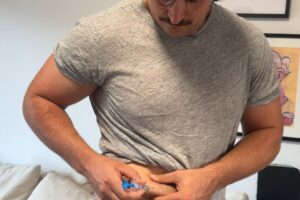
“You can barely feel the needle going in.”
The side effects built gradually. A headache on day one. Lower back pain by day two or three. He managed it with two Panadol morning and night.
“I’d describe it more as if you’d incorrectly done deadlifts. More of an ache, an inconvenience than a solid pain.”
Donation day
When you donate stem cells, blood goes out one arm, through a machine that extracts the excess stem cells, and the rest of the blood is returned through the other. The process takes five or six hours. For the full picture of what happens to your body when you donate stem cells, we’ve got you covered.
“You don’t feel anything. You just sit there.”
“It’s nothing in comparison to what the recipient is going through,” he says. “It’s a very small price to pay.”
“The scariest part was setting my alarm for 4am.”
By the end Stefan was asleep in the chair.
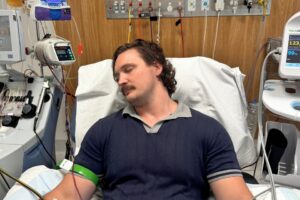
Proof that you can take a nap while saving a life
Why Stefan did it
Stefan didn’t donate because he had spare time. He donated in his first week of his first job, on broken sleep, having negotiated a day off he hadn’t yet earned.
St Vincent’s Hospital has a motto. Give to the poor for free what the wealthy can afford. For Stefan, it’s the same principle.
“What we as the healthy have is stem cells. Why don’t we all just give them to those who are poor of health.”
“I’m donating my stem cells to someone I’ve never met before. And I think that’s kind of cool.”
Sign up. Follow through.
Stefan has one thing to say to anyone thinking about joining the stem cell donor registry.
“Sign up. But sign up only if you intend to follow through. Because to get that call that you’re a match and then to get cold feet, I think that’s worse than not signing up at all. It’s a bit of a fraud.”
He’s not wrong. Around 35 percent of Australians who register and get the call say no.
“If you’re scared of needles, don’t sign up. If you don’t want a bit of sleep disturbance or some low back pain, don’t sign up. Because the hope you would instil in a family when they’re told there’s a match, and then you pull out, it seems a bit pointless.”
But if you’re in, be in.
“You may never get the call. But if you do, it’s such a small price to pay for someone who has no other options.”
Stefan registered because TLR’s founder walked into a lecture theatre and told a stem cell donation story. He chose to show up in his first week as a nurse at the hospital where TLR’s story began. He fell asleep in the chair, went back to work the next day, and got on with it.
That’s what a stem cell donation story looks like when it goes full circle.
Sign up through the TLR Foundation’s partner page.
Be a legend. Save a life.