Elise Toyer didn’t think she’d end up in cancer nursing. She had all these ideas about what kind of nurse she wanted to be, and haematology wasn’t one of them. Then she walked onto the transplant and haematology ward at Westmead Hospital as a new graduate, and everything changed. Today, Elise is a Clinical Nurse Consultant in haematology at Blacktown Hospital in Western Sydney. She’s also TLR’s first Nurse Practitioner Scholarship recipient, marking a new chapter for the foundation as it expands beyond the Master of Cancer and Haematology Nursing to support nurses taking the next step into advanced practice.
TLR is incredibly proud to be backing haematology nurse practitioners, and even prouder that Elise is the first. None of it would be possible without the people who fundraise through events like the City2Surf. Every dollar raised goes towards helping nurses like Elise gain the qualifications that make a real difference to patients.
From terrified new grad to the safe pair of hands
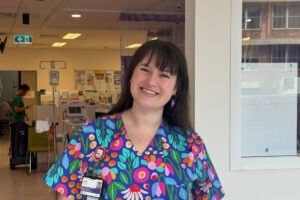
The safe pair of hands
Elise is the first to admit that her start in haematology wasn’t graceful. “I didn’t take to it like a duck to water,” she says. “I took to it like a Baby Yoda, screaming, things flying everywhere.”
But the senior nurses around her kept her there. They could sit with a patient going through something terrifying and not be scared by it themselves. Elise wanted to learn how to do that.
“That was the thing when I was like, okay, that’s what I want to learn how to be,” Elise says. “I want to be that safe set of hands.”
It’s a phrase she comes back to throughout our conversation. The safe set of hands. For her patients, for her colleagues, for the junior nurses she now mentors. It’s what pulled her from new grad to Clinical Nurse Educator at Westmead, then to Cancer Care Coordinator and Clinical Nurse Consultant at Blacktown. And it’s what’s driving her towards becoming a nurse practitioner.
What a nurse practitioner actually does
Most people have never heard of a nurse practitioner, and even within the health system the role isn’t always well understood. Elise puts it simply: you get all the best parts of having a really senior nurse with deep expertise in your area, plus the ability to prescribe, order imaging, and interpret pathology. It’s holistic care from someone who stays in that specialty long term.
“A haematologist’s job is to try and manage the disease,” she says. “A nurse’s job is to try and manage the symptoms and how the person’s coping with it. That role match is so perfect.”
The numbers tell the bigger story. There are probably only about 150 specialty advanced practice haematology nurses across Australia, and fewer than two dozen nurse practitioners. But those nurses are passionate about bringing more people onto the pathway. “The amount of interest since TLR announced it’s going to be supporting nurse practitioners has been huge,” Elise says.
Building a haematology service at Blacktown
When Elise arrived at Blacktown in 2022, the haematology service was small. The perception was there weren’t enough haematology patients to justify a full-time care coordinator.
Elise didn’t buy it. “It’s the chicken and the egg,” she says. “If you don’t have enough staff to safely manage those patients, you’re restricted in how much you can take.”
Then the service expanded. Blacktown doubled its haematology team, and Elise led six months of education work across the hospital to make sure they could safely manage sicker patients. They expected four acute leukaemia patients a year. They got closer to sixteen.
Now Elise is adding a second master’s degree on top of all of it. She’s studying part time, one unit per semester, so her patients don’t wear the cost of her being away. “The patient who’s in front of me and needs me should never be losing out because I’ve got that extra on my plate,” she says.
“If I’m just trying to rush through it to get it done, I’m not going to be actually learning,” she says. “The patients are more important.”
The trade-off is real. Her weekends and evenings go to studying. “My backyard is up to here,” she says, pointing at her waist. “We’re using the air fryer a lot. Air fryer and pre-packaged microwave vegetables. Protein bars. The poor man’s meal prep.”
She thinks it’ll take about three and a half years. TLR isn’t counting. Most nurses completing a master’s degree are also working full time, and rushing through it can come at the cost of the work that matters most. It doesn’t matter how long it takes. What matters is the quality of the nurse at the end of it.
What the nurse practitioner scholarship means
Elise found out about TLR through the University of Sydney. Her course coordinator sent it to her directly and said she should have a look. She hadn’t heard of TLR, but it didn’t take long.
“Reading who TLR was and what they did and their whole approach to it, I said these are my people,” she says. “It’s so important to be an expert and to be dynamic, but also to make sure you’re focusing on the joy. They get it.”
Removing the financial burden of a second master’s degree is part of it. But for Elise, the biggest part was something else entirely.
“On the health politics side, it’s a lot of fighting for people to understand why having an NP matters,” she says. “You get the imposter syndrome and think maybe I’m pushing too hard, or maybe it isn’t as necessary as I think it is. And then when you get that external validation, it’s so rewarding. This is really hard, but it does matter. And it doesn’t just matter to me, so I can do it.”
More nurses like Elise
On World Blood Cancer Day this year, Elise will be at Blacktown Hospital helping organise a stem cell donor drive. Blacktown is one of the most multicultural communities in Australia, and for patients from diverse backgrounds, the chances of finding a matching donor on the registry are significantly lower. Having a nurse like Elise connecting her hospital to that cause is exactly what TLR was built for.
The people of Blacktown are lucky to have her. Elise has already completed her Master of Cancer and Haematology Nursing at the University of Sydney. She’s already built a haematology service that’s treating four times the patients anyone expected. She’s already mentoring the next wave of junior nurses, telling them the same thing that kept her going when she started: it’s heavy because it’s important. Find the value in what you do, and then find the fun.
Now she’s going further. Haematology in Australia needs more nursing leaders, and TLR is proud to support their first haematology nurse practitioner, and an incredible one at that. The first of many. Elise set out to become the safest set of hands for her patients and her colleagues. She’s well on her way.
If you’re a haematology nurse looking to take your career to the next level, find out more about TLR’s nursing scholarships.