Most people who look into donating stem cells assume they won’t qualify. Too old, wrong background, too many tattoos, that thing they did last weekend. It’s one of the biggest reasons people never sign up. They rule themselves out before they’ve even checked. So who can donate stem cells in Australia, and what actually matters when it comes to eligibility? The answers are simpler than most people think.
Who Can Donate Stem Cells in Australia
You need three things to join the stem cell donor registry. You need to be aged 17 to 35, in good general health, and you need a green or blue Medicare card. That’s the whole list.
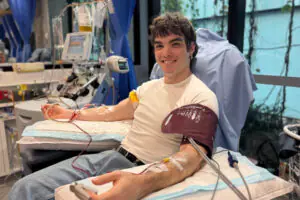
Oscar donating stem cells
The age window recently dropped to 17 through the cheek swab pathway, which means you can register before you’ve even finished Year 12.
Once you’re on the registry, you stay on until you turn 60. So 35 isn’t the age you stop being useful. If you’re over 35, you can still make a difference by spreading the word or helping someone in the right age range sign up.
Matching doesn’t come down to blood type. It comes down to tissue type, which you inherit from your parents. Siblings have roughly a 25 percent chance of matching. For the roughly 75 percent who don’t find a match in their family, the registry is their best shot. That’s where you come in.
What Would Actually Rule You Out
There are some things that do rule you out, and they’re about protecting both you and the person receiving the transplant.
If you’ve had cancer, that’s the main one, with the exception of two minor skin cancers: basal cell carcinoma and squamous cell carcinoma. If you’ve had either of those, you’re still eligible. Severe autoimmune conditions like lupus, multiple sclerosis, rheumatoid arthritis, Crohn’s disease, or type 1 diabetes would also rule you out. Some milder autoimmune conditions like coeliac disease, psoriasis, or Hashimoto’s thyroiditis may still be fine, depending on how stable things are.
Beyond that, the exclusions include having had an organ or bone marrow transplant, a stroke or heart attack, or living with HIV or HTLV. Certain blood disorders like thalassaemia major, sickle cell disease, and haemophilia are also on the exclusion list.
If you’re not sure where you sit, that’s what the sign-up process is for. They’ll tell you clearly and early if something means you can’t go ahead.
Can I Donate Stem Cells If I Smoke or Vape?
Yes. Smoking and vaping aren’t on the exclusion list. You can register as a stem cell donor whether you smoke cigarettes, vape, or do both.
If you’re ever matched and called to donate, the medical team will do a full health assessment beforehand. But smoking or vaping on its own won’t stop you from signing up or staying on the registry.
Can I Donate Stem Cells If I Have Tattoos?
Yes. This one catches people off guard because tattoos used to rule you out of donating blood in Australia. That’s not the case anymore or for donating stem cells.
You can sign up with as many tattoos as you like. The only thing worth knowing is that if you got a tattoo in a developing country, there may be a short deferral period before you can donate, usually around three months. But that’s a temporary pause, not a permanent exclusion, and it doesn’t stop you from joining the registry in the meantime.
Can I Donate Stem Cells If I’ve Taken Drugs?
This is the question nobody asks out loud, so we’ll answer it here. Recreational drug use isn’t on the exclusion list for joining the stem cell donor registry. Your registration doesn’t ask what you did last Saturday.
The one thing that used to be flagged was intravenous drug use, and even that doesn’t rule you out anymore. You can still join through the cheek swab pathway.
The important distinction is between signing up and actually donating. Registration can happen any time. If you’re ever called to donate, which could be years down the track, the medical team does a full health check to make sure you’re good to go. So the registry isn’t interested in your weekends. The doctors just want to make sure you’re healthy when it counts. And if you’re one of the legends that comes up as a match, maybe don’t plan a big weekend in the weeks leading up to donation day.
What Else Won’t Rule You Out
Low iron or anaemia won’t permanently exclude you. Both are temporary deferrals, which means you can still sign up now and be cleared to donate once your levels are back to normal. The same goes for pregnancy and breastfeeding. You can’t donate during either, but it’s a pause, not a permanent exclusion.
Who you love or how you identify makes zero difference to joining the registry. Your sexuality and gender identity aren’t part of the eligibility criteria at all. TLR has written about this because it matters, and it’s worth a read if you’ve ever wondered whether you’re welcome. You are.
And no, you don’t have to be male. Doctors often prefer male donors for clinical reasons, mainly because they tend to produce a higher volume of stem cells, but women are absolutely needed on the registry. Every person who signs up gives one more patient a chance at finding their match.
Ready to Join?
Most people on the registry never get the call. But if you do, you could be the only person in the world who can help someone with blood cancer get a second chance.
Signing up takes a few minutes, just remember to do the swabs and post them back. Don’t leave them on the kitchen counter.
Sign up through the TLR Foundation’s partner page. Be a legend. Save a life.