If there’s one part of stem cell donation that freaks people out, it’s the injections. Not the donation itself, not the time in the chair, not the blood going out and coming back in. Specifically, the injections before donating stem cells that start five days before donation day.
Some donors give these to themselves at home. Others have a nurse do it at a clinic. Some even get a friend to do it. Either way, here’s what donors actually say once they’ve been through it: it’s not that bad. In fact, some go further than that. Stefan, a donor and registered nurse, put it simply: “I’ve had paper cuts that are worse.”
If the thought of a few jabs is enough to put you off saving a life, the stem cell donor registry might not be for you. That’s ok. It’s not for everyone. But for most donors, the reality is a lot less dramatic than it sounds.
The injections
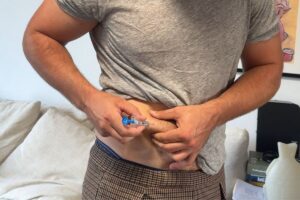
Same needle millions of people use for insulin every day
Before you donate stem cells through your blood, you’ll have a few days of jabs with a medication called G-CSF. It stands for granulocyte colony stimulating factor, which is a mouthful nobody needs to remember. What matters is what it does.
Your bone marrow makes stem cells all the time. They’re the starter cells that turn into red blood cells, white blood cells, and platelets. Normally, they stay put inside the marrow. G-CSF tells your bone marrow to ramp up production and push those stem cells out into your bloodstream. Once they’re circulating, your medical team can collect them on donation day through a process called apheresis. Think of it like donating plasma. No surgery, no general anaesthetic, no operating theatre. About 90 percent of donations in Australia happen this way.
The other 10 percent donate bone marrow directly from the hip under general anaesthetic. That takes about 45 minutes, there’sno jabs in the lead up, and your backside will have opinions for a few days afterwards.
Your medical team talks you through both options, and you’ll always have a say in how you donate. If you want to know what each method actually involves, the risks blog walks through both honestly.
How the jabs work
The needle is tiny. Same type millions of people use for insulin every day, so this isn’t exactly experimental territory. It goes just under the skin, usually in the belly, and takes a few seconds. How many you get depends on your body.
How you get them is entirely up to you. Some donors go to a clinic each day and have a nurse handle it. Others do it themselves at home after being shown how. Some rope in a housemate or partner. There’s no wrong answer.
Stefan is a registered nurse who’s given thousands of injections to other people. Doing it to himself was a different story: “Injecting myself for the first time, there definitely was a bit of trepidation. But after the second or third time, you’re pretty good.”
Aadil, who’d never injected anything before, also chose to do it himself: “I think the psychological aspect was worse than the actual physical aspect. The first time, I was like, oh my God, I have to do this. But it actually doesn’t hurt much because the needle’s so sharp and goes straight in.”
If two donors with completely different experiences of injections before donating stem cells both landed on “it’s fine,” that tells you something.
Side effects
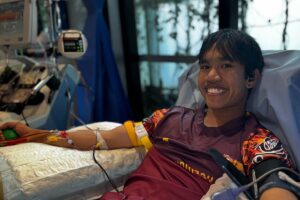
Charles had no side effects from the G-CSF.
Everyone responds to G-CSF differently. Charles, a 20 year old donor from Canberra, had zero side effects from his G-CSF injections. Not a headache, not an ache, nothing. That happens more often than people expect.
Some donors notice their body working harder than usual. The most common side effects are muscle aches, lower back pain, and feeling a bit run down. That makes sense when you think about it. Your bone marrow is producing stem cells at a rate it doesn’t normally have to, and it lets you know about it.
Stefan described it as “a low ache, like you’ve been doing deadlifts with the wrong technique rather than a stabbing pain.” Aadil had similar aches in his lower back and shoulders, especially when he woke up: “I took some Panadol, and mostly I felt fine.”
Side effects build up over the injection days, but they don’t stick around. Paracetamol, rest, and a warm shower go a long way.
What happens on donation day
Once the jabs are over, you’ll head to a hospital or collection centre for the donation itself. The apheresis machine draws blood from one arm, filters out the excess stem cells, and returns the rest via your other arm. It takes around five or six hours, and most donors say it’s pretty boring. You’re not locked in place, but the nurses prefer you keep movement to a minimum. So if you get an itch on your nose or want a sip of water, that’s what your support person is for. Most donors pass the time listening to a podcast, chatting with the nursing staff, or watching Netflix.
After that, any lingering side effects from the injections ease within a day or two, and your body replaces the donated stem cells on its own. If you want to know what the days after look like, the recovery blog has everything you need.
Your medical team carefully prepares your donated stem cells and delivers them to the patient who needs them. For that person, what you just sat through could be the difference between everything and nothing.
Ready to join?
Most people who sign up to the registry will never be called. But if you do get that call, a few days of injections before donating stem cells and five or six hours in a chair could give someone a second chance at life.
If you’re aged 18 to 35, it starts with a cheek swab kit mailed to your home. Sign up through the TLR Foundation’s partner page.
Be a legend. Save a life.