Abbey’s mum, fondly known as Crazy Aunty Maggie, had already been through one stem cell transplant when her blood cancer came back. The first time, an anonymous donor on the registry matched with her. This time, doctors wanted to try something different.
They tested Abbey. She turned out to be a half match. Using a half-matched family member like a son, daughter, sibling or parent is called a haploidentical transplant. It used to be considered a last resort. These days, it’s saving lives where doctors can’t find a full match.
Abbey didn’t know much about stem cell donation at the time. She admits the whole thing felt overwhelming at first. But the team at St Vincent’s explained every step, and once she understood what was involved, she didn’t hesitate.
“It was obviously a no brainer. If there was even the slightest chance it could help Mum beat this beast of a disease, I was in.”
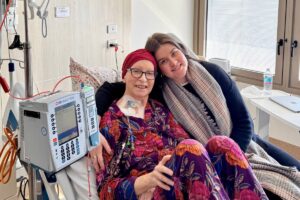
Abbey and her mum Maggie during her stem cell transplant
What donating stem cells was actually like
Before all of this, Abbey assumed the worst.
“That donating stem cells means getting your bones drilled into, like some horror scene from Grey’s Anatomy. Spoiler alert, it’s nothing like that.”
The team at the Kinghorn Cancer Centre, part of St Vincent’s Hospital in Sydney, walked Abbey through every step before she went in. Once the process made sense to her, the nerves settled. The scariest part was just not knowing what to expect.
The process involved a few days of G-CSF injections, a medication that encourages the body to release extra stem cells into the bloodstream. Abbey says they didn’t hurt, and the only side effect she noticed was some mild bone aches for a day or two. On donation day, she spent five hours sat in a chair connected to a machine that filtered out the stem cells and returned the rest of her blood.
The team looked after her the whole time. She had snacks, watched some daytime TV, and took one day off to donate, another to recover, then went straight back to work. No surgery, no long recovery. Just a couple of days and it was done.
The very next day, Abbey watched as the team transfused her stem cells into her mum. After that, Maggie began round the clock care at St Vincent’s Hospital in Sydney.
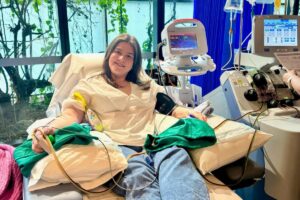
Five hours, some snacks and daytime TV. That’s what donating stem cells looks like.
The person she did it for
Abbey and Maggie have always been close. As a single mum raising an only child, Maggie did everything. She worked, she showed up, she made it all happen. Even at 66, Abbey says she still gives her a run for her money socially.
“She’s hands down my favourite person on the planet.”
The transplant process hasn’t been easy for either of them. Maggie spent weeks in hospital, and Abbey was there through all of it. Long days, hard conversations, and a lot of waiting. The two of them have always operated as a team, and this was no different. Despite everything, Abbey says the silver lining has been how much time they’ve spent together through it all. Not the circumstances either of them would have chosen, but time together all the same.
What happened after the transplant
Maggie’s doing well. Her doctors are pleased, she’s back home in Wagga, and she’s slowly getting back to life with Abbey by her side.
One of the wildest things about this kind of transplant is what happens after. Maggie now has Abbey’s blood type. Every white blood cell in her body runs on her daughter’s immune system. Her body is essentially rebuilding itself from the inside out using Abbey’s cells.
Most people don’t realise that’s how it works. When a stem cell transplant succeeds, the donor’s cells take over completely. The recipient’s blood and immune system become the donor’s. In this case, mother and daughter are now connected at a level that goes well beyond genetics.
Abbey travelled from Wagga, gave up a couple of days, sat in a chair, and watched some TV. In return, her mum got a whole new immune system. As far as gifts go, that one’s hard to top.

Maggie’s back home and getting stronger every day
Abbey’s message
When asked whether she thinks people should sign up to the stem cell donor registry, Abbey doesn’t hold back.
“Do it. One hundred percent. I had no idea the stem cell register even existed, and I definitely would have thought donation involved some scary, painful process. In reality, it’s a few injections and a few hours in a chair.”
“I’m now on the registry and would absolutely do it again. Especially to pay it forward for the anonymous donor who helped Mum the first time around.”
That detail matters. Before Maggie had Abbey as an option, a complete stranger on the registry gave her a chance. Someone who signed up, got the call, and said yes. Abbey saw firsthand what that meant for her family.
Still, not everyone has a family member who can donate. Maggie was lucky twice. First an anonymous donor, then her daughter. Some people with blood cancer have no match at all.
Could you be someone’s match?
Most people who join the registry will never get the call. But if you do, Abbey reckons you’ll wonder what all the fuss was about.
If you’re aged 17 to 35 and have a valid Medicare card, all it takes is a short form and a few simple cheek swabs.
Sign up through the TLR Foundation’s partner page.
Be a legend. Save a life.
References
TLR Foundation – Become a Stem Cell Donor