Jenny Nixon gave blood 104 times before she ever needed any back. She started at eighteen, kept going until fifty, and never made a fuss about it. That was just Jenny. Between donations she was raising two sets of twins on her own, running a baking business in Wagga Wagga, and building a reputation as the self-professed Queen of Melting Moments. She never imagined she’d need a stem cell transplant, let alone a second stem cell transplant a few years later.
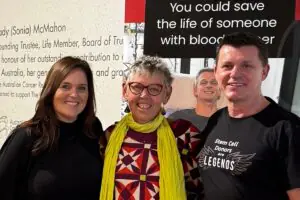
Jenny at a stem cell donor drive at Sydney’s Kinghorn Cancer Centre
How Jenny learned she had blood cancer
Two days before Christmas 2016, her haematologist called. A routine blood test had led to more tests. The diagnosis was myelodysplasia, or MDS, a blood cancer that stops the body making healthy blood cells.
“It’s a damn scary diagnosis,” she said. “But it’s like anything. Unless you suffer from it, you really don’t know.”
When the treatment stopped working
Doctors tried other options first. Nothing held. Every few weeks Jenny was back in hospital for blood transfusions, and every time the effect wore off faster. By the end of each cycle she couldn’t make it to the front door.
Her doctors were honest with her. The only thing left was a stem cell transplant, and that meant finding a stranger whose stem cells matched hers.
There was no match anywhere in Australia. The search went global, and a donor was found in Germany. Someone who’d joined a registry years earlier, probably never expecting the call. When it came, he said yes.
“I was incredibly lucky. They found a donor within a couple of months.” Not everyone does.
What a stem cell transplant is actually like
Jenny had her allogeneic stem cell transplant at St Vincent’s Hospital in Sydney in 2018. After months of blood transfusions, failed treatments, and a worldwide search for a donor, the actual transplant was a bit of an anticlimax.
“It was somewhat of a let down,” she said. “Because it was just into my arm like a blood transfusion.”
What came after wasn’t.
Within a week she developed a bowel infection and was moved to intensive care. Then came another infection, severe pneumonia, and kidney failure. Her children were called to say goodbye.
She doesn’t know how she pulled through.
Jenny spent four months in hospital, most of it in bed. She couldn’t walk to the shower. She couldn’t get to the toilet on her own. Before they’d let her leave, she had to prove she could toast a slice of bread and boil a kettle.
She failed that test twice. Third time, she nailed it and was finally allowed to go home to Wagga, cancer free.
A second blood cancer, and a second stem cell transplant. Are you serious?
Four and a half years later, just as she was planning a trip to Africa, Jenny got the news no one wants to hear twice. Acute myeloid leukaemia. A completely different blood cancer. Back to the start.
She needed a second stem cell transplant, which meant finding another matching donor. Again, there was no match in Australia. Again, the match came from Germany.
That’s not a coincidence. Germany has one of the largest stem cell donor registries in the world. Millions of people have signed up, which is why Australian patients so often end up relying on German donors when there’s no match closer to home. Both of Jenny’s donors were German. They’d signed up years before she ever got sick, and when the call came, they said yes.
Jenny had her second stem cell transplant in June 2023. This time she was out in 36 days. Compared to four months and a failed toast test, she called it “a walk in the park.”
Meeting Lars
After her first transplant, Jenny was eventually able to meet the man whose stem cells saved her life. In Australia, donors and recipients don’t connect straight away. There’s a two year waiting period where any contact stays anonymous and goes through Stem Cell Donors Australia. After that, if both people are comfortable, they can meet.
His name is Lars. He’s an engineer from Germany who works for Volkswagen. He’d joined the registry years before Jenny got sick, probably thought nothing of it, and got on with his life.
“You can’t really put into words what it means to meet someone who gave you your life back.”
They still keep in touch. Every time Jenny does something special she sends him a photo. A trip up Mount Kosciuszko. A milestone with her grandkids. A quiet reminder that the decision he made years ago is still giving her new ones.
“He didn’t only give me life, he gave me a lot of opportunities.”
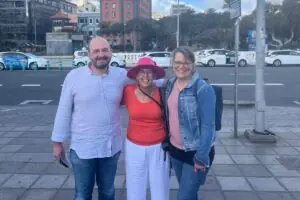
Jenny meeting Lars, the stem cell donor from Germany whose decision gave her a second chance at life
Why Jenny shares her stem cell transplant experience
These days Jenny lives with ongoing fatigue and her baking business has slowed down. But she’s not the type to sit still. She volunteers with Cycling Without Age in Wagga, she supports other patients in her community going through treatment, and she talks to anyone who’ll listen about why Australia needs more people on the stem cell donor registry.
“My circle of people in my life, they had no idea they could be on a stem cell donor register.”
That’s the part that frustrates her. Not what she went through, but the fact that so many people don’t know how simple it is to sign up or how much it matters. Both of her donors came from Germany because there was no match on the Australian registry. She’d like to change that.
How you can help
Jenny’s stem cell transplant only has a good ending because two people were already on the registry when she needed them. Not after her diagnosis. Not because someone asked them to. They signed up years earlier, spent a few minutes on it, and went on with their lives.
If you’re aged 17 to 35, in good general health and eligible for Medicare, you can join the Australian stem cell donor registry in a few minutes. It starts with a couple of cheek swabs sent to your door. No blood test. No hospital visit.
If you’re outside that age range or not eligible to join, you can still make a difference. A donation to the TLR Foundation helps put someone else on the registry in your place. Every new donor on the registry is another chance for someone like Jenny.
And if nothing else, share this story. The more people who know the registry exists, the better the odds for every patient waiting for a match.
Be a legend. Save a life.