You signed up. You posted the cheek swab kit back. You’ve been told you’re on the Aussie stem cell donor registry. And then nothing. No call, no dramatic moment where a doctor tells you you’re someone’s only hope. If you’re wondering what the chances of being called to donate stem cells actually are, and why most people never are, the short answer is that you’re one of over 43 million people on registries around the world, and matching is far more specific than most people realise.
That’s not a bad thing. It just means the bar for a match is a lot higher than most people expect.
It comes down to genetics, not you
When someone needs a stem cell transplant, their doctors aren’t looking for someone with the same blood type. They’re looking for something way more specific called HLA markers. These are proteins on the surface of your cells that your immune system uses to tell the difference between what belongs in your body and what doesn’t.
You inherit your HLA markers from your parents, half from your mum and half from your dad. Because those markers get passed down through family lines, people from similar ethnic backgrounds are more likely to share them. Doctors usually want to match at least eight of them between donor and patient, sometimes more. And because there are millions of possible combinations, the chances of any two unrelated people lining up that closely are ridiculously small.
A sibling only has a 25 percent chance of being a match. For most patients, that means there’s a 75 percent chance they’ll need to find a complete stranger with the right HLA markers. That’s where you come in. And when a match does happen, it can be the only thing standing between that person and running out of options.
What are the odds of getting that call?
The answer is really low. In Australia, the odds are roughly one in 1,500. If you’re from a more diverse background the odds are higher, but it’s still unlikely. Most people who sign up will never be matched to a patient.
That can feel anticlimactic. You signed up expecting something to happen, and then years go by without a word. Mitch waited 20 years between signing up and getting the call. But the reason the odds are so low for any one person is the same reason registries need as many people as possible. The more people on the list, the better the odds of finding the right person when someone’s life depends on it.
Why your background changes the odds
Your HLA markers are inherited, which means they’re closely tied to your ancestry. People from the same ethnic background are more likely to share similar markers, and that’s where the gap shows up. Australia’s registry doesn’t reflect the diversity of the people who actually live here. Right now, around 80 percent of stem cell donations for Australian patients come from overseas.
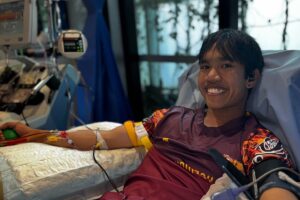
Charles on stem cell donation day
For people from Asian, Middle Eastern, Pacific Islander, African, or mixed heritage backgrounds, the pool of potential matches on the Australian registry is small. More people from those communities signing up changes that.
First Nations Australians face a uniquely different challenge. The genetic diversity within Aboriginal and Torres Strait Islander communities is so broad that overseas registries offer essentially no help. The only way to close that gap is more First Nations Australians joining the registry. For someone searching for a match right now, that could make all the difference.
What happens if you do get the call
If you are that special person who comes up as a match, Stem Cell Donors Australia gets in touch. You’ll go through some additional blood tests and a health check to confirm you’re a good match and fit to donate. The whole process is guided by a donation coordinator who walks you through every step.
Most donations happen through the bloodstream. You have a few days of injections beforehand that get your body producing extra stem cells, and on donation day you sit in a chair for five or six hours while a machine collects them. It’s a lot like donating plasma. Around 10 percent of donors are asked to donate bone marrow instead, which is a short procedure under general anaesthetic. Either way, the final call on how you donate is always yours.
You can read more about what the donation process actually looks like if you want the full picture.
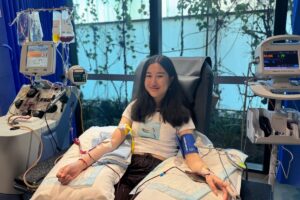
Ling on stem cell donation day at the Kinghorn Cancer Centre
Why staying on the registry still matters
The fact that you haven’t been called doesn’t mean your registration was pointless. It means no one has needed your specific combination of HLA markers yet. That could change tomorrow, or it might never change at all. Either way, you being on the registry keeps that door open for someone.
The one thing that can make your registration count for nothing is if Stem Cell Donors Australia can’t reach you. If you’ve moved house, changed your number, or got a new email address, update your details. It takes two minutes. You don’t want to be the right match for someone and have the call go to an old number.
You might never get the call. Most people don’t. But if you do, it’ll be because you’re the one person who can help. And that’s worth being on the list for.
If you’re not on the registry yet and you’re aged 17 to 35, it takes a few minutes and a cheek swab. Sign up through the TLR Foundation’s partner page.
Be a legend. Save a life.